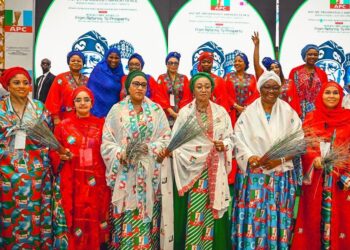
Nigeria’s First Lady, Senator Oluremi Tinubu, has launched the National Community Food Bank Programme, targeting 500,000 vulnerable households nationwide in its first year, as a total of N65 billion was mobilised from government and private sector stakeholders to support the initiative.
The programme, unveiled in Abuja, is designed to tackle hunger and improve nutrition among vulnerable populations, particularly children under the age of six, in line with the Renewed Hope Agenda of President Bola Ahmed Tinubu.
Speaking at the launch and inauguration of the Board of Trustees of the Community Food Bank Trust Fund, the First Lady described the initiative as a sustainable intervention aimed at improving access to nutritious food and strengthening community-based nutrition systems across the country.
She explained that the programme is being implemented in collaboration with key government institutions, including the Federal Ministry of Health and Social Welfare, the National Primary Health Care Development Agency, and the Bank of Industry, noting that food banks globally have proven effective in bridging the gap between food surplus and demand.
Senator Tinubu also led by example with a personal donation of N500 million, while acknowledging major contributions from organisations and institutions. These include N10 billion pledged by the Nigerian National Petroleum Company Limited over five years, N500 million from the Sir Emeka Offor Foundation, and N17 billion from the Federal Government through a special Social Action Fund intervention.
In addition, the Nigeria Governors’ Forum pledged a matching N17 billion, while anonymous donors contributed $500,000, further boosting the fund.
Chairman of the NGF and Governor of Kwara State, Abdulrahman AbdulRazaq, said state governments would support the initiative to address rising food insecurity and malnutrition, noting that more than one-third of Nigerian children under five are stunted.
He described the situation as a national concern with implications for economic growth and development, assuring that governors would work closely with the Federal Government to ensure the programme’s success.
Also speaking, the Coordinating Minister of Health and Social Welfare, Mohammed Ali Pate, described nutrition as both a national and moral imperative, stressing that access to adequate food is critical to reducing under-five mortality and improving overall public health outcomes.
According to him, the Federal Government has already approved N17 billion under the Social Action Fund to support community-based nutrition efforts and decentralise interventions to grassroots levels.
On his part, Minister of Agriculture and Food Security, Abubakar Kyari, said the initiative represents a shift from reactive responses to a more structured and coordinated approach to tackling food insecurity.
He cited alarming statistics, including the estimated 12 million Nigerian children under five who are stunted and the significant contribution of malnutrition to child mortality, alongside post-harvest losses of up to 60 percent in some perishable crops.
Representing the Association of Local Governments of Nigeria, Hamisu Mohammed emphasised the importance of grassroots implementation, describing local governments as critical to the success of the programme.
Meanwhile, Managing Director of the Bank of Agriculture, Ayodeji Sotinrin, disclosed that the fund would operate under strict transparency and accountability measures, including a ring-fenced account and multi-level approval processes for disbursement.
He added that distribution of food items would leverage the nationwide network of primary healthcare centres to ensure that beneficiaries are reached at the ward level across all 36 states.
The Board of Trustees of the Community Food Bank Trust Fund includes Senator Oluremi Tinubu as Chairman, with key public sector stakeholders serving as members to provide oversight and strategic direction.
The National Community Food Bank Programme is expected to be rolled out across Nigeria’s six geopolitical zones as part of broader efforts to combat hunger and improve nutrition nationwide.