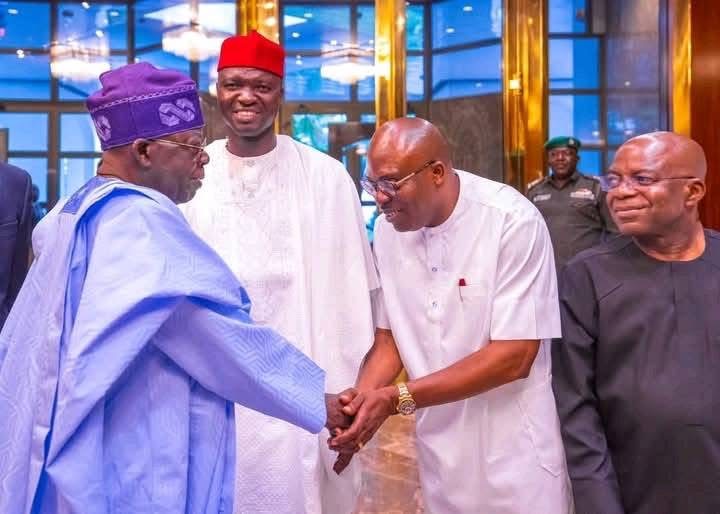
Suspended Rivers State Governor, Siminalayi Fubara, is reportedly ready to make political concessions—and possibly defect to the ruling All Progressives Congress (APC)—to ease the prolonged crisis in his state and regain his seat.
This comes after a private meeting with President Bola Tinubu in London during the President’s recently concluded 18-day European retreat.
According to The Africa Report, the meeting was held at Fubara’s request and was his first face-to-face with Tinubu since the March 18 declaration of emergency rule in Rivers State.
A senior presidential adviser told the French-based outlet that Fubara “pledged to make certain concessions in a bid to ease tensions,” with ongoing negotiations hinting that his six-month suspension may be lifted earlier than September.
“He has promised to make some compromises,” the source said. “Negotiations are progressing well, and he could be reinstated before the suspension ends.”
In a dramatic twist, another aide disclosed that Fubara is also weighing a defection from the opposition Peoples Democratic Party (PDP) to the APC—potentially boosting Tinubu’s grip on the politically strategic, oil-rich state ahead of future elections.
“If Fubara joins the APC, the president’s chances in Rivers State rise significantly,” the aide noted.
Fubara’s ouster stemmed from a bitter feud with his estranged political godfather, Nyesom Wike, now Minister of the Federal Capital Territory.
The power struggle exploded in December 2023 when Fubara ordered the demolition of the state’s House of Assembly complex. That act, coupled with the defection of 27 pro-Wike lawmakers to the APC, triggered a constitutional crisis and a legal tug-of-war.
On February 28, the Supreme Court ruled in favor of the defected lawmakers, accusing Fubara of unconstitutional actions that reduced Rivers to a “one-man rule.” Despite the verdict, governance remained gridlocked, and by March 2025, the state’s annual budget had yet to be passed.
Tensions reached a breaking point when back-to-back pipeline explosions rocked parts of Rivers State in March—incidents Tinubu linked to militant groups allegedly loyal to Fubara.
Citing threats to national stability and economic sabotage, the president invoked Section 305 of the Constitution, suspended Fubara and his deputy, and installed retired Navy Chief, Vice-Admiral Ibok-Ete Ekwe Ibas, as sole administrator.
With mounting pressure from PDP governors challenging the legality of the emergency rule, Tinubu’s recent dialogue with Fubara could signal the beginning of a political truce.
While Wike was noticeably excluded from the London meeting—and reportedly uneasy about being sidelined—Tinubu is expected to meet with all key players, including Wike and the Rivers lawmakers, in a bid to broker lasting peace.
For now, all eyes remain on Fubara—who may be walking a political tightrope back to power.