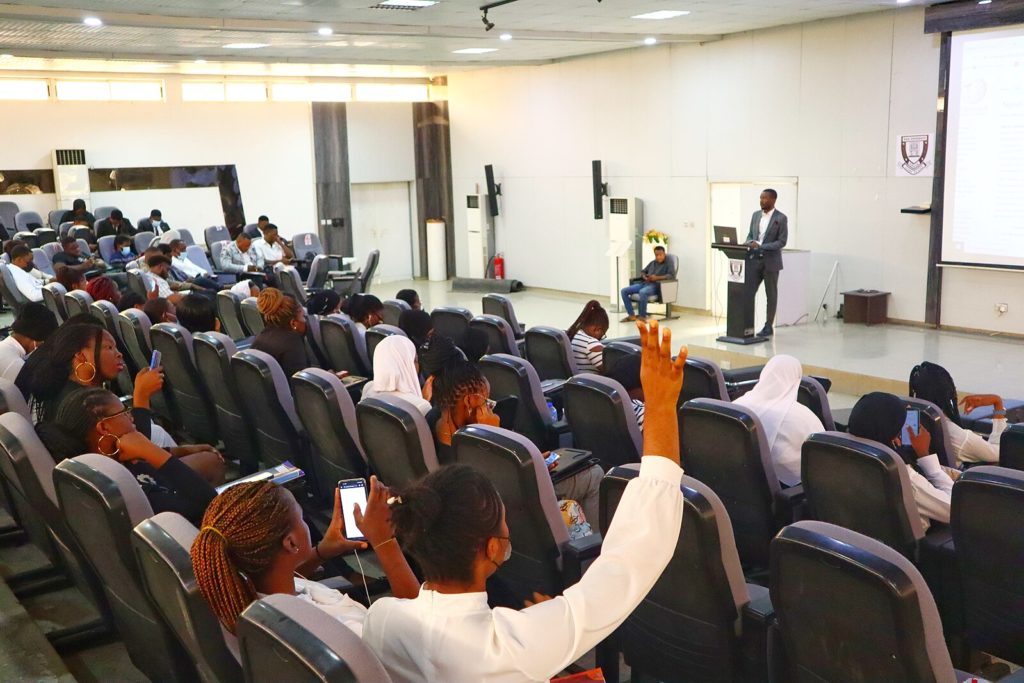
Holding an audience spellbound for two straight hours is impressive. But when both in-person and virtual attendees remain glued to their screens and the conversation still continues long after the lecture ends, signals something extraordinary.
It wasn’t just a professorial presentation, it was a challenge, a roadmap, and a wake-up call at the 4th African School of Economics Lecture Series. Participants who joined physically and virtually sat through an intellectual rollercoaster and did not have the chance to be bored.
The session was led by Prof. Moses Ochonu of Vanderbilt University, and masterfully hosted under the visionary leadership of Prof. Mahfouz Adedimeji, who believes that “ideas rule the world”. These lecture series are his brainchild, designed to bridge the gap between academia and society, between the gown and the town.
Speaking to an audience of Vice Chancellors, NUC representative, scholars, and university stakeholders, Prof. Ochonu explored the theme: “The 21st Century Nigerian University: Pitfalls and Pathways.”
He challenged the longstanding model of education that prioritises rote informational mastery over innovation. He made a powerful case for revamping the curriculum to equip students with skills that actually matter: critical thinking, creativity, adaptability, tech fluency, and problem-solving.
He also called for
revamping the craft of teaching by establishing teaching centres and instituting award for teaching excellence. He canvassed for dedicated teaching universities that focus on instruction without the burden of research if they do not have the facility to do so. On the flip side, he suggested that other universities fit for research should be designated as research universities , each being formally established as such. He called for reforms in promotion criteria to reward both excellent teaching and quality research.This would restore prestige to the neglected craft of teaching and encourage specialisation, excellence and efficiency.
He advocated the idea of Writing centres in all universities as writing is central to learning and scholarly exchange in all fields. This will help tutor students and academics who desire it to communicate their research outcomes with ease. Investment in writing centres, writing coaches and consultants is a worthy investment, according to him and I absolutely concur.
He did not shy away from calling out deep-rooted issues such as, academic inbreeding, poor supervision, outdated teaching methods, and irrelevant programmes. His call was deprovincialising and de-politicising the university system.
He also pitched a Students’ Bill of Rights to ensure quality supervision, timely feedback, and respectful academic relationships.
He urged the NUC to loosen the tight grip of uniform regulations so universities can innovate in ways that reflect their local context and strengths. He cited an example of allowing for single course enrollments by the NUC for professionals who desire to upskill in emerging areas, update their knowledge or satisfy new curiousities. This is an avenue for universities to fill the gap and also generate revenue.
I attended the lecture virtually, and it left me deeply inspired because it offered clear, practical solutions. It was a masterclass in insight and relevance.
The message was clear: If Nigerian universities are to remain relevant in this rapidly changing world, reform is urgent. Now, it is up to academic leaders, lecturers, policy makers and stakeholders to take this vision seriously and push for the changes our institutions desperately need.
Adebola Karamah Shogbuyi, PhD.