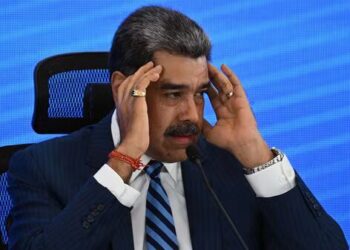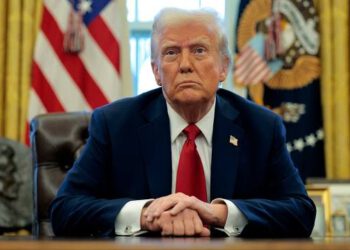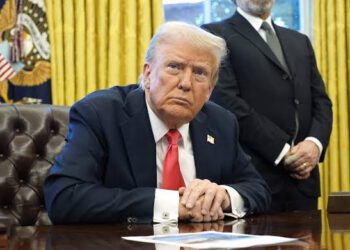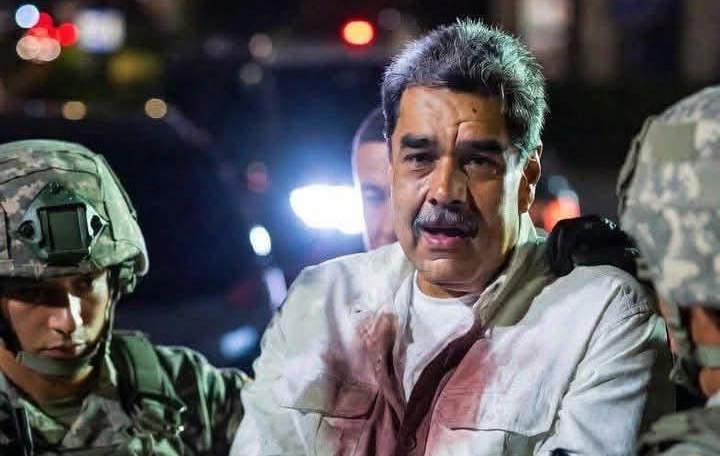
US President Donald Trump on Saturday claimed that American forces had captured Venezuelan President Nicolás Maduro following what he described as a “large-scale military strike” on Venezuela, triggering a night of explosions and panic in the capital, Caracas.
Posting on his Truth Social platform, Trump said US troops had successfully carried out an operation that led to the arrest of Maduro and his wife, adding that both had been flown out of the country. His statement came about two hours after loud explosions and heavy aerial activity were reported across Caracas in the early hours of the morning.
Venezuela’s government, however, did not confirm Maduro’s capture. Instead, it condemned the operation as an “extremely serious military aggression” by the United States, accusing Washington of escalating months of sustained military and economic pressure against the South American nation.
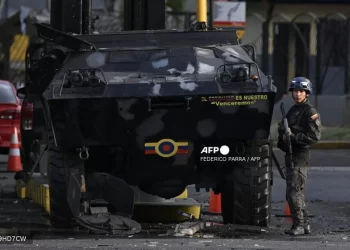
AFP journalists reported that around 2:00 a.m. local time, multiple explosions rocked Caracas, accompanied by the sound of helicopters overhead. The blasts reportedly lasted close to an hour, sending residents scrambling for safety.
Trump announced plans to address the operation later in the day from his Mar-a-Lago residence in Florida. In a brief phone interview with The New York Times, he praised the mission as “brilliant,” crediting what he called careful planning and the performance of US troops.
Among the reported targets were Fuerte Tiuna, Venezuela’s largest military complex in southern Caracas, and the Carlota airbase in the northern part of the city. AFP observed flames and thick smoke rising from Fuerte Tiuna, while additional explosions were heard in La Guaira, home to Caracas’s main airport and seaport.
Residents described scenes of fear and confusion as the strikes unfolded. Some said power was cut in parts of the capital, while others gathered essential documents and supplies in anticipation of further violence.
In an official statement, the Venezuelan government said Maduro had declared a state of emergency, though his whereabouts were not disclosed. The defence ministry accused US forces of striking residential areas and announced a large-scale mobilisation of its military assets.
Regional tensions also rose sharply. Colombian President Gustavo Petro called for an emergency meeting of the United Nations and ordered troops to the Venezuela–Colombia border.
The strikes followed repeated warnings from Trump, who had recently reinforced US naval presence in the Caribbean. Washington has long accused Maduro of leading a drug trafficking network, allegations the Venezuelan leader has consistently denied, insisting the US is targeting his government because of Venezuela’s vast oil reserves.
In recent weeks, the United States had intensified pressure on Caracas through expanded sanctions, seizures of Venezuelan oil shipments, and restrictions on airspace. US forces have also carried out multiple operations against vessels in the Caribbean and Pacific, which Washington says were linked to drug trafficking.
As events continued to unfold, uncertainty remained over Maduro’s fate and the broader implications of what could mark one of the most dramatic escalations in US–Venezuela relations in years.